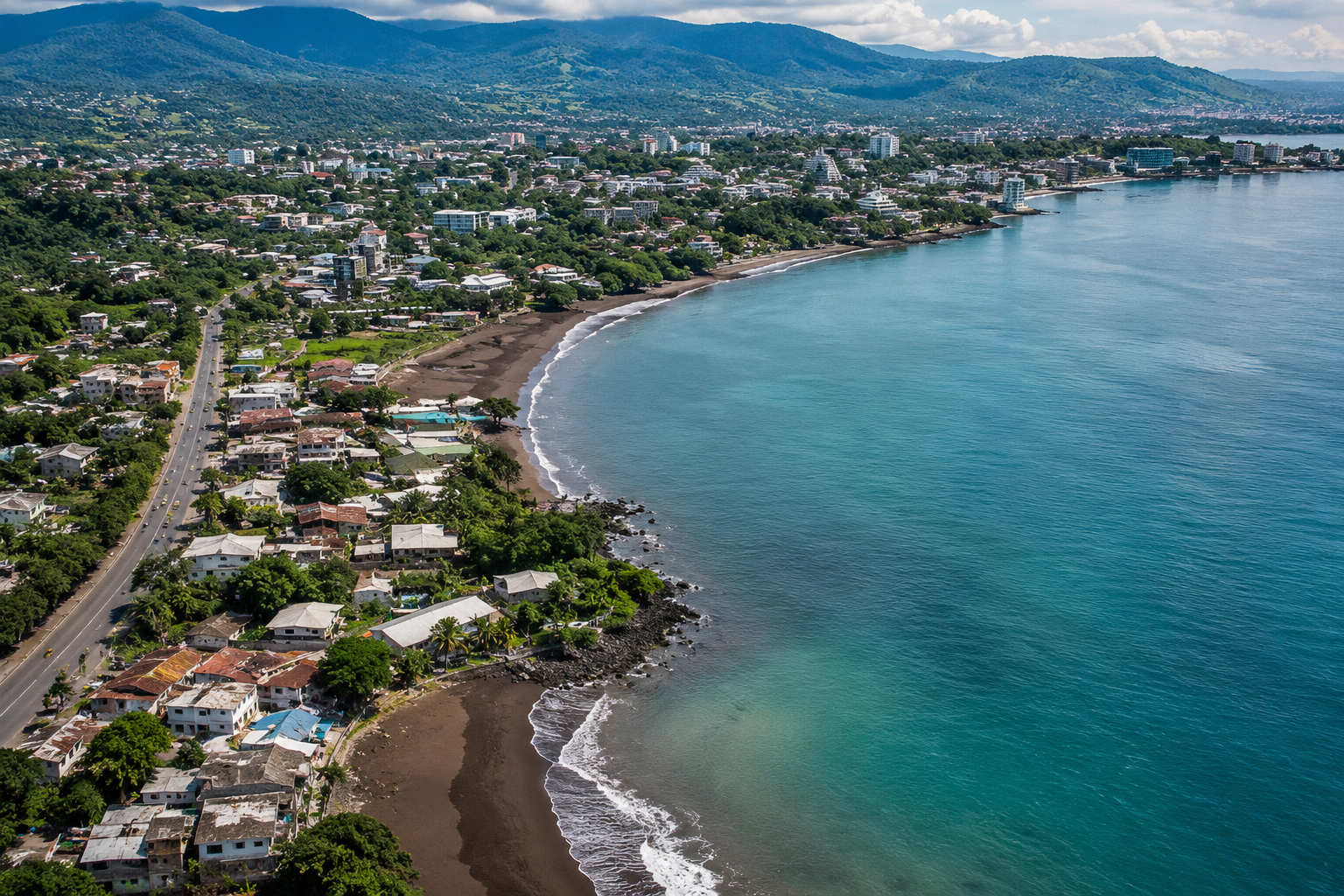
402 km of underutilised coastline. A tourism economy ranked 117th out of 119 globally. A correctable condition.
Institutions, investors and networks aligned to Cameroon's Atlantic corridor.





The Numbers Behind the Corridor
All metrics sourced from published institutional data. Estimates are labelled. Data gaps are documented in the Research Library.
Coastal Investment Readiness Score
Every opportunity on Cameroon Atlantic is evaluated using a structured 100-point framework — assessing land, demand, infrastructure, sustainability, community, viability, management and execution speed.
Total: 100% · Framework v1.0 · CCII Proprietary Methodology
Project Compass™
Capital is already moving. Two projects illustrate the depth of hospitality investment momentum forming within Limbe's corridor.
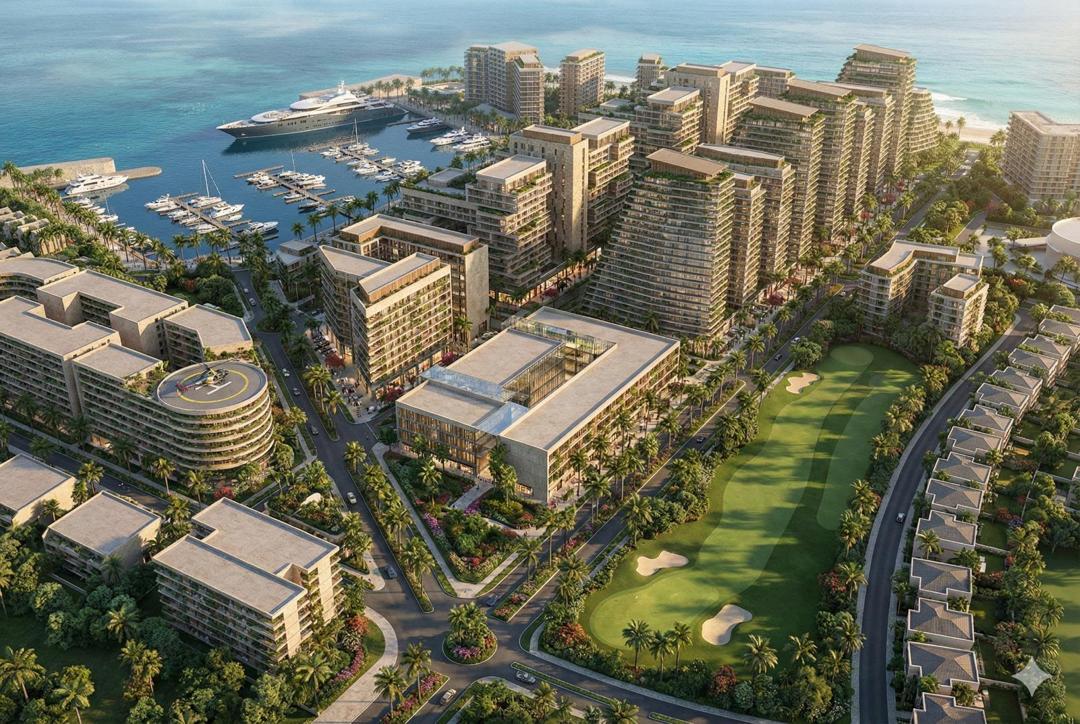
Enrich Resort City™
A 125-acre government-approved master resort development — the most significant hospitality investment signal in Limbe's history.

Limbe Palms Hotel
An operational boutique hotel establishing quality accommodation benchmarks in an undersupplied market.
Project profiles are presented as strategic market signals for research purposes only. Not investment advice or endorsements.
How Would You Like to Engage?
Research. Partnership. Investment. Execution.
Cameroon Atlantic is a research and intelligence platform. It does not sell properties or guarantee investment returns. All opportunities are presented for research and due diligence purposes only.

Investment Opportunities
Identifying the sectors, projects and economic ecosystems shaping Cameroon's Atlantic future.
The coastline is more than a destination. It is an emerging economic corridor where tourism, hospitality, infrastructure and real estate intersect to create long-term value.
The Scale of the Opportunity
The Asset We Have Not Fully Measured
Cameroon possesses 402 km of Atlantic coastline, a deep-water port handling 12.7 million tonnes annually, an international airport serving 22+ destinations, and ecological assets found nowhere else on the West African coast.
The asset exists. The strategy does not — yet.
Three Structural Signals
The conditions that convert potential into an investable moment.
Infrastructure Momentum
Kribi port Phase 2 commissioned May 2025. $154M AfDB road allocation approved. $200M World Bank land reform project launched. The physical foundation is being built.
Africa Tourism Growth
$168B continental tourism GDP in 2024. Coastal tourism projected to exceed $100B by 2030. 24M+ jobs supported continent-wide. The demand trajectory is structural, not cyclical.
CFA Currency Stability
XAF pegged to the Euro since 1948. Exchange-rate stability that free-floating African currencies cannot offer investors. A structural monetary anchor others lack.
The Coastal Value Engine
How tourism becomes an investment asset class. The value creation sequence — from visitor access to capital liquidity.
"Tourism gives real estate a reason to perform beyond speculation. The ecosystem is the investment thesis."
Tourism demand drove the property market — not the reverse. 92% peak occupancy. ~$998M revenue.
Cameroon is at step 01. Every subsequent step depends on decisions made now — in access, experience and investment packaging.
Investment Themes
Six primary investment categories represent the current opportunity landscape. Each theme includes a detailed investment thesis, demand analysis, market gaps and capital requirements.
Opportunity Matrix
A comparative view of investment categories ranked by demand, capital requirement, risk profile and near-term readiness.
| Opportunity | Category | Demand | Capital Req. | Risk | Timeline | Readiness |
|---|---|---|---|---|---|---|
| Holiday Homes | Real Estate | 12–18m | ||||
| F&B / Restaurants | Hospitality | 6–12m | ||||
| Eco-Lodges | Eco-Tourism | 18–30m | ||||
| Serviced Apartments | Real Estate | 12–24m | ||||
| Boutique Hotels | Hospitality | 24–36m | ||||
| Wellness Retreats | Hospitality | 18–30m | ||||
| Cultural Attractions | Heritage | 24–36m | ||||
| Conference Hotels | Hospitality | 36–48m | ||||
| Marina Development | Marine | 48–72m | ||||
| Mixed-Use Districts | Real Estate | 60–84m |
Why Limbe Is First
Limbe is not the only opportunity — it is the first city selected for deep analysis because it combines the highest concentration of natural assets, existing tourism infrastructure and near-term investment readiness along the corridor.
Coastal Nodes Comparison
Each coastal node has a distinct strategic identity, asset base and development horizon. Matching capital to the right geography is critical to investment success.
What Is Holding Investment Back
Barrier severity — composite assessment. Each barrier is addressable. None are structural to the geography.
West Africa tourism grew 48% between 2014–2019. The bottleneck is investability, not visitor interest.
No investor can commit capital to land they cannot legally secure. Documentation is prerequisite, not detail.
Cape Verde showed the model: route incentives + airport investment + demand creation = connectivity. It is a policy choice, not a geographic constraint.
"Every barrier identified is addressable. None are structural to the geography. All are functions of policy, capital and coordination."
What Others Understood Earlier
Six African and Atlantic economies transformed comparable natural assets into investable corridors. Their strategies, models and lessons are directly applicable to Cameroon's coastline.
Conservation can command $1,500+/night. Brand protection creates irreversible premium positioning.
Cultural differentiation prevents commoditisation and sustains yield at scale.
Policy innovation unlocked $1B+ of coastal real estate investment from a single regulatory framework.
Narrative and brand are infrastructure. Investor confidence was built before the physical product.
Air access is the single greatest unlock for island and coastal tourism economics.
Long-term government commitment to a destination vision creates durable, compounding investor confidence.
Coastal Investment Readiness Score
The CIRS is a composite 100-point framework developed by CCII to assess site-level investment readiness across the Atlantic corridor.
Every opportunity in the CCII pipeline is assessed against this framework before being presented to investors — ensuring consistent, transparent, evidence-led evaluation.
Opportunity Pipeline
A curated view of opportunities currently under CCII review. Detailed documentation — financials, legal framework, operator profiles — available following investor registration.
From Interest to Investment
CCII exists to reduce information gaps and help stakeholders move from curiosity to informed, structured decision-making.
Register Investor Interest
Registration provides access to the full investor brief, detailed opportunity documentation, research reports and direct engagement with the CCII team.
The Atlantic Opportunity Is Not a Single Project
It is a long-term effort to transform one of Central Africa's most overlooked economic corridors into a more investable, connected and productive ecosystem.
The future will not be built through speculation. It will be built through research, infrastructure, partnerships, responsible investment and sustained execution.
Five Nodes. Five Investment Identities.
402 km of coastline — five distinct economic corridors.
Volcanic black-sand beaches unique on the West African coast. Botanic Garden (1892). Wildlife Centre. Mount Cameroon.

Limbe
Not the only opportunity — the most compelling starting point.
75 km from Douala. Volcanic black-sand beaches found nowhere else on West Africa's coast. One of Africa's oldest botanical gardens. A wildlife centre drawing 50,000 visitors a year. Mount Cameroon rising 4,095m directly behind the city.
Limbe's competitive advantages are not hypothetical. What does not yet exist is the documentation, packaging, and professional management infrastructure to convert them into investable opportunities.
Project Compass™
Projects demonstrating market momentum within Limbe's hospitality, tourism and coastal investment ecosystem.
The following profiles illustrate the type of capital deployment already occurring within Limbe's hospitality and destination development ecosystem. These projects are presented as strategic market signals — evidence that the investment thesis is not theoretical.
These profiles are presented for research and informational purposes only and do not constitute investment recommendations, endorsements or financial advice. Cameroon Atlantic is an intelligence platform, not an investment intermediary. Images shown are reference imagery pending receipt of official project visuals.
Enrich Resort City™
A 125-acre government-approved master resort development — the most significant hospitality investment signal in Limbe's history.
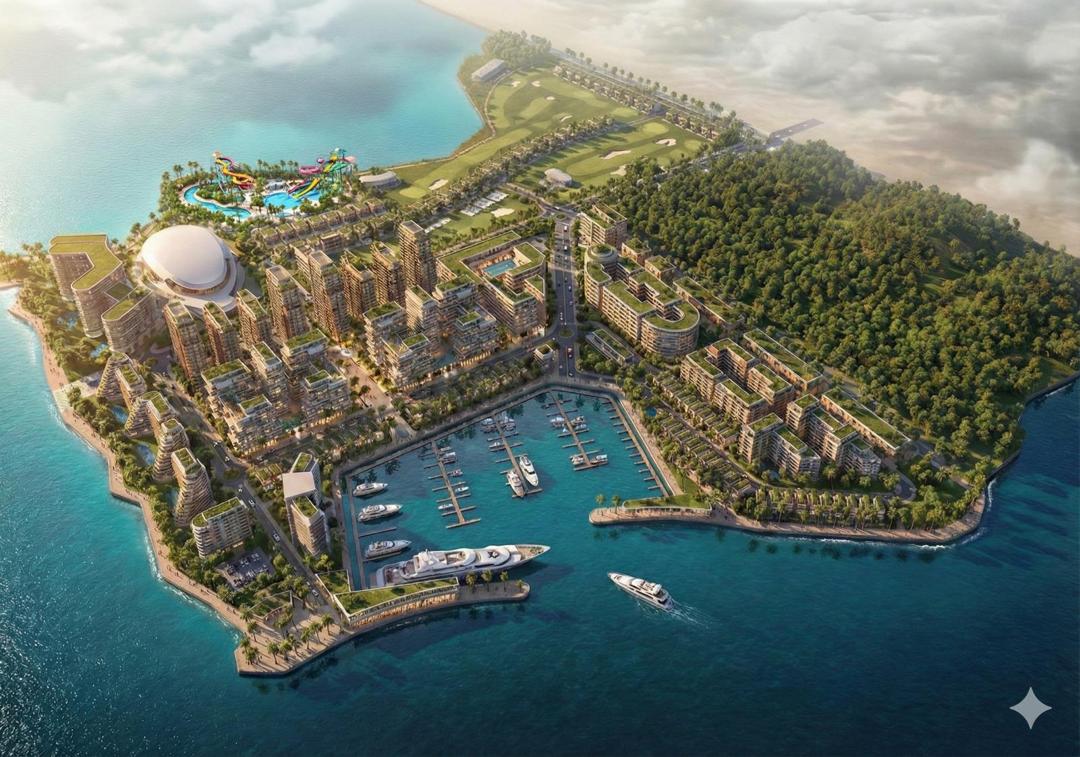
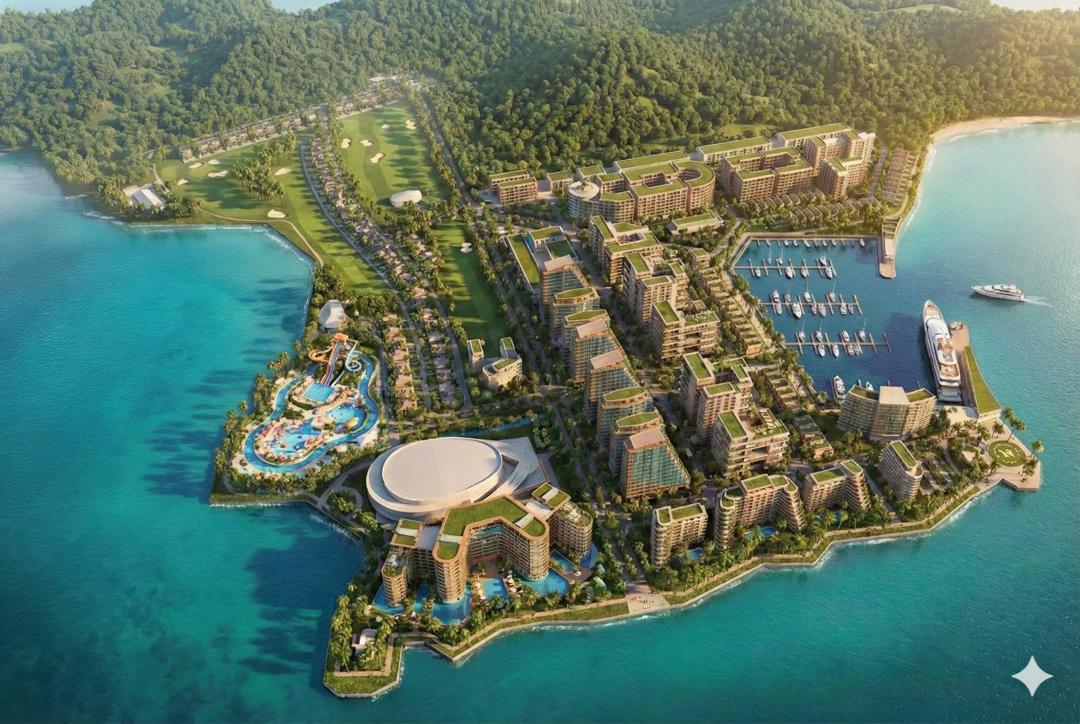
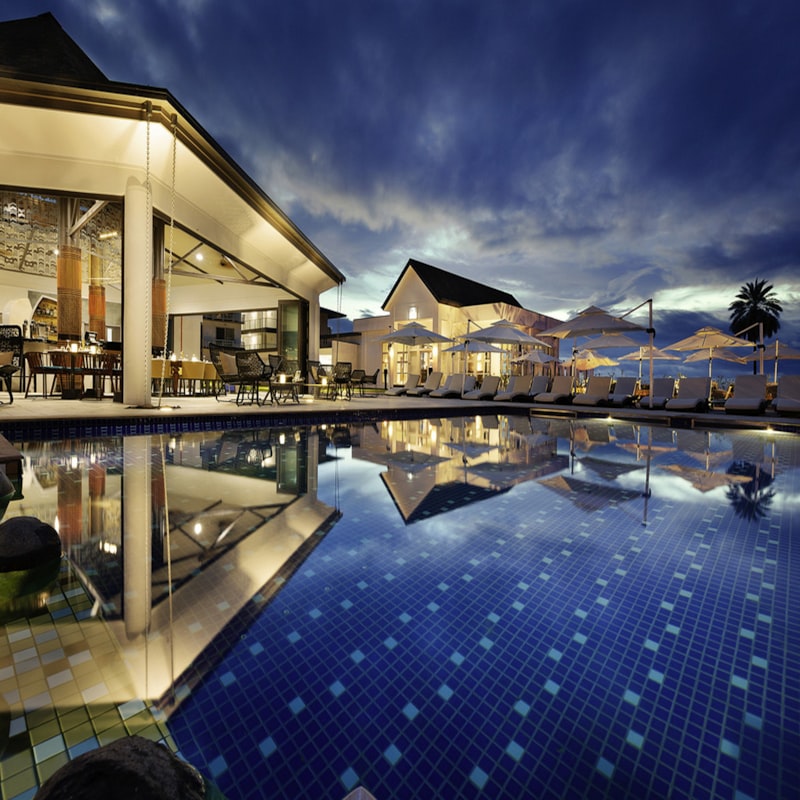
Enrich Resort City™ is a 125+ acre master-planned development integrating luxury hospitality, managed residences, a full-service marina, championship golf, conference infrastructure, smart utilities and renewable energy systems within the Limbe–Mondoli Corridor. The project was formally approved by the Government of Cameroon at the National Tourism Council Extraordinary Session on 7 April 2026. International partners include Marriott Hotels, Enrich Network Corp (Canada), Makinen Suisse SA (Switzerland), and Supernova Energy.
Marriott Hotels · Enrich Network Corp (CA) · Makinen Suisse SA (CH) · Supernova Energy · Twiga Connect
A government-endorsed, internationally partnered, 125-acre mixed-use development is not a speculative concept — it is a structural market signal. Projects of this scale establish destination credibility, attract hospitality brands, create infrastructure that anchors smaller operators, and generate the pricing and demand data that de-risks further capital deployment across the corridor. Enrich Resort City™ validates the foundational Cameroon Atlantic thesis: when the right infrastructure is built, private capital follows.
Limbe Palms Hotel
An operational boutique hotel establishing quality accommodation benchmarks in an undersupplied market.



Limbe Palms Hotel is an operational hospitality property serving the growing business, diaspora and leisure visitor market in Limbe. The property represents the type of quality accommodation infrastructure that supports destination maturation — providing market evidence on occupancy patterns, room rate benchmarks and visitor profiles that reduce information risk for prospective investors and operators considering entry into the corridor.
Independent Operator
Operational hotels in undersupplied markets do more than accommodate guests — they generate the data points that investment decisions depend on. Pricing transparency, occupancy patterns and guest demographics from active properties reduce information asymmetry, establish benchmarks for new entrants and provide the market evidence that transitions a destination from speculative to investable. Limbe Palms Hotel represents this early-stage market formation in real time.
Three Phases. One Direction.
From evidence to activation to a fully capitalised Atlantic corridor.
- Coastal research database
- Limbe site audit & hotel inventory
- Diaspora investor survey
- Website & investor network launch
- First facilitated site visits
- Boutique hotel pipeline
- Tourism experience development
- Operator & developer outreach
- Diaspora investment products
- Government institutional engagement
- Coastal master planning
- Gulf aviation connectivity
- Hospitality brand attraction
- Structured investment vehicles
- Annual Opportunity Report
Research Library
CCII's credibility is built on a single principle: every claim is sourced, every estimate is labelled, and every data gap is named.
This library contains the research, analysis and intelligence that underpins every investment thesis, coastal node assessment and opportunity evaluation on this platform.
Research Reports
Baseline analysis of the 402 km Atlantic corridor — geographic assets, current utilisation, infrastructure inventory and economic context.
Detailed breakdown of Cameroon's 117/119 WEF ranking — understanding the components, addressable gaps and pathway to improvement.
Full methodology documentation for the CCII proprietary CIRS framework. Criteria definitions, weighting rationale and scoring protocols.
Comparative analysis of Rwanda, Zanzibar, Mauritius, Senegal, Cape Verde and Morocco. Investment models, lessons and applicability to Cameroon.
Site-level analysis of Limbe as the CCII demonstration city. Assets, constraints, market gaps, hospitality inventory and investment themes.
Analysis of Cameroonian diaspora capital flows, investment appetite and potential vehicles for structured coastal investment participation.
Port, airport, road and utilities audit across the five coastal nodes. Current capacity, planned investments and infrastructure gaps.
Short-stay accommodation demand analysis, pricing benchmarks, rental yield observations and managed inventory assessment.
Full report access available following investor registration · CCII Research Programme, 2024–2025
Data Gaps
These are the acknowledged gaps in current research — areas where data is incomplete, unavailable or requires future collection. Publishing this register is a deliberate act of institutional transparency.
Gap register updated as research progresses · CCII Data Standards, 2024
Research Methodology
All data is categorised: Verified (published institutional sources), Estimated (derived with methodology notes), or Gap (acknowledged absence of data). Gaps are never filled with assumptions.
Every data point carries its source date. Tourism data is subject to significant lag. Where multiple years are cited, the most conservative figure is used unless otherwise stated.
CCII does not manufacture data to strengthen arguments. Where data is unavailable, this is stated explicitly. 'Data Collection In Progress' is an honest answer, not a placeholder.
International comparisons use consistent metrics across countries. No benchmark is selected solely because it flatters the Cameroon narrative.
All research documents are versioned. Updates are published when new data becomes available. Version history is preserved.
Access the Full Research Database
Complete reports, raw data, source documentation and forthcoming publications are available to registered investors and research partners.
Reframing Cameroon's
Atlantic Economy
Cameroon Atlantic is an independent investment intelligence and economic development platform focused on unlocking long-term value across Cameroon's Atlantic corridor.
Despite possessing strategic ports, coastal cities, tourism assets, growing urban populations and direct Atlantic access, Cameroon's coastline remains significantly under-researched, under-positioned and undercapitalized compared to many competing markets.
Cameroon Atlantic exists to close that gap — through research, market intelligence, project evaluation and stakeholder engagement — providing investors, developers, policymakers and diaspora communities with a clearer understanding of the opportunities shaping Cameroon's coastal economy.
What We Do
Investment Intelligence
Data-driven research, market analysis and economic insights focused on Cameroon's Atlantic economy — structured to meet institutional standards.
Opportunity Mapping
Identification and assessment of opportunities across tourism, hospitality, infrastructure, real estate and the blue economy.
Project Readiness Assessment
Evaluation of opportunities through the Coastal Investment Readiness Score (CIRS) — a structured 100-point proprietary framework.
Investor Facilitation
Connecting credible opportunities with investors, strategic partners, developers and diaspora stakeholders through structured engagement.
Strategic Focus Areas
Five sectors where Cameroon Atlantic concentrates its research, intelligence and facilitation work.
Tourism & Hospitality
Hotel development, boutique lodges, destination marketing, visitor experience and accommodation infrastructure.
Coastal Real Estate
Waterfront residential, serviced apartments, mixed-use development and managed property investment.
Infrastructure & Connectivity
Road access, port logistics, aviation connectivity, utilities and public-private partnership opportunities.
Marine & Blue Economy
Fisheries, maritime tourism, marina development, offshore logistics and sustainable ocean enterprise.
Diaspora Capital Mobilisation
Structured pathways for diaspora investors to access, participate in and benefit from Cameroon's growth story.
Stakeholders Across the Atlantic Economy
Cameroon Atlantic operates at the intersection of research, investment, development and economic transformation. Our work is designed to support stakeholders involved in shaping the future of Cameroon's Atlantic economy.
Government & Public Institutions
National ministries, regional authorities, municipal councils and investment promotion agencies.
Development Finance Institutions
Organizations supporting infrastructure, tourism, enterprise development and long-term growth.
Private Equity & Investment Firms
Investors seeking access to emerging opportunities and long-term value creation.
Family Offices & HNW Investors
Capital partners exploring hospitality, real estate and strategic development opportunities.
Real Estate Developers
Developers evaluating mixed-use, hospitality and destination-led projects.
Hospitality & Tourism Operators
Hotel groups, resort operators and tourism brands.
Infrastructure & PPP Partners
Stakeholders involved in transport, logistics, utilities and public-private partnerships.
Diaspora Investors & Networks
Diaspora stakeholders seeking structured pathways to participate in Cameroon's growth story.
Research Institutions & Universities
Academic and policy organizations supporting evidence-based development.
Strategic Corporate Partners
Organizations seeking partnerships, expansion opportunities and market intelligence.
The Opportunity Is Not
The Coastline
The opportunity is what can be built around it.
Across Africa, some of the continent's most successful economic stories have emerged where geography, infrastructure and investment converge.
Cameroon's coastline possesses many of the same ingredients. The challenge is not the absence of opportunity — the challenge is visibility, readiness and coordinated investment.
Cameroon Atlantic exists to help bridge that gap.
To Capital
To establish Cameroon's Atlantic corridor as one of Central Africa's most attractive destinations for tourism, enterprise, infrastructure development and long-term investment.
The Institution Behind the Platform
Fai S. Derick is the founder of Cameroon Atlantic and the Cameroon Coastal Investment Initiative (CCII), an independent platform established to reframe how Cameroon's Atlantic economy is understood, positioned and accessed by international and diaspora investors. His work sits at the intersection of investment intelligence, economic development strategy and Gulf-Africa capital mobilisation.
"Cameroon Atlantic is not a brokerage, a fund or a consultancy. It is an intelligence platform — a long-term institutional project designed to provide the research, frameworks and stakeholder connections that serious investors need before capital moves."
The platform was built on the conviction that Africa's under-researched coastal markets are not under-performing because of a lack of opportunity — but because of a lack of structured, credible, investment-grade intelligence. Cameroon Atlantic exists to produce exactly that.
Cameroon Atlantic is an independent research and intelligence platform. It does not provide financial advice, sell properties or guarantee investment returns. All content is for research and informational purposes only.
The Conversation
Starts Here
CCII is inviting early participants. First-mover access to verified opportunities.
“Cameroon's Atlantic coastline should be treated as an investable economic corridor, not merely as a collection of beaches.”